
What Is Cervical Spondylosis — Clinical Overview
Cervical spondylosis is a broad term describing age-related degenerative changes in the cervical spine — the seven vertebrae of the neck (C1 to C7), their intervertebral discs, ligaments and the associated facet joints. As the spine ages, the discs lose water content and height, the cartilage covering the facet joints wears down, and bony outgrowths called osteophytes (bone spurs) may form. These changes collectively narrow the spaces through which the spinal cord and nerve roots pass, potentially causing pain, stiffness, and neurological symptoms.
The condition is classified into three main types based on which structures are predominantly affected. Cervical spondylosis without myelopathy involves degenerative changes with neck pain and stiffness but without spinal cord compression. Cervical radiculopathy occurs when nerve roots are compressed, causing pain, numbness or weakness radiating down one or both arms. Cervical myelopathy — the most serious form — involves compression of the spinal cord itself, causing progressive neurological deficits including difficulty walking, hand clumsiness and bladder dysfunction.
| Type | Main Features | AYUSH Suitability |
|---|---|---|
| Cervical Spondylosis (simple) | Neck pain, stiffness, morning tightness | All AYUSH approaches appropriate |
| Cervical Radiculopathy | Arm pain, numbness, tingling | Gentle yoga only — medical supervision essential |
| Cervical Myelopathy | Hand weakness, walking difficulty, bladder issues | Medical priority — AYUSH supportive only after stabilisation |
Cervical Spondylosis in India — The Scale and Context
Cervical spondylosis has historically been considered a condition of older adults — and indeed, research confirms that over 85% of individuals above 60 years show radiological evidence of cervical degeneration. However, clinical practice in India is increasingly showing a much younger demographic presenting with cervical symptoms, driven by factors unique to the modern Indian context.
Key Indian Context:
• Over 85% of individuals above 60 show cervical degeneration on imaging
• Rapidly rising incidence in 25 to 45 age group — India’s young working population spending 8 to 12 hours daily at screens
• Smartphone neck (forward head posture from phone use) is a significant emerging driver — Indians average over 6 hours daily on smartphones
• IT sector workers, students, teachers and drivers are the highest-risk occupational groups in India
• Indian anatomical factors — a 2024 retrospective analysis of 2,667 cervical spine surgery patients at an Indian tertiary centre found Indian patients present at younger ages than Western populations
• Poor ergonomics in both home and office settings — low desks, no lumbar or neck support, floor-level work postures all contribute
• Delayed diagnosis — many Indians dismiss persistent neck pain as muscle strain for years before seeking assessment
The combination of genetic predisposition, dietary factors (particularly calcium and vitamin D deficiency which accelerates bone degeneration), occupational stress, and the dramatic increase in sedentary screen-based work has made cervical spondylosis one of India’s most significant and growing musculoskeletal health challenges — affecting productivity, quality of life and mental health across millions of working-age Indians.
Symptoms of Cervical Spondylosis — Know What to Watch For
| Symptom | Description | When It Occurs |
|---|---|---|
| Neck pain and stiffness | Dull, aching pain — worst in morning and after sitting long hours | Most common presenting symptom |
| Reduced neck mobility | Difficulty turning head fully to either side | Progressive — worsens without treatment |
| Headache | Typically starts at base of skull, radiates forward | Common — often misdiagnosed as tension headache |
| Arm pain and tingling | Radiating down one or both arms — nerve root compression | Indicates radiculopathy — needs medical evaluation |
| Shoulder pain | Referred pain from cervical nerve roots to shoulders | Often confused with rotator cuff problems |
| Dizziness and vertigo | Cervicogenic dizziness from vertebral artery involvement | Requires careful assessment — do not self-manage |
| Hand weakness or clumsiness | Dropping objects, difficulty with fine motor tasks | Indicates myelopathy — urgent medical attention needed |
Seek Urgent Medical Attention If You Have:
• Progressive weakness in arms or legs
• Difficulty walking or frequent falls
• Loss of bladder or bowel control
• Sudden severe neck pain after injury
• Numbness or weakness affecting both arms simultaneously
• Dizziness that worsens with neck movement
These symptoms may indicate cervical myelopathy or spinal cord compression requiring urgent neurosurgical evaluation. Do not attempt yoga or any self-treatment without medical clearance for these symptoms.
10 Simple Yoga Poses for Cervical Spondylosis — With Steps and Precautions
Yoga is the most widely studied AYUSH approach for cervical spondylosis. Research from ClinicalTrials.gov (NCT03526965) — a randomised controlled pilot trial titled “Yoga Chikitsa for Neck Pain Caused by Cervical Spondylosis” — demonstrated clinically meaningful improvements in pain, range of motion and functional capacity with yoga therapy. A 2020 study confirmed that yoga is more effective in maintaining efficacy and preventing symptom recurrence than passive treatments alone. A systematic review confirmed Iyengar yoga’s effectiveness for spinal neck pain, and a 2018 study showed simplified Kundalini Yoga worked in the majority of cervical spondylosis cases.
The following ten poses are specifically selected for their safety profile and therapeutic relevance to cervical spondylosis — they either gently mobilise the cervical spine, strengthen the supporting musculature, decompress the cervical nerve roots, or improve the overall postural alignment that underlies the condition. Every pose should be practised without force, with slow coordinated breathing, and without producing or worsening any pain or tingling in the arms.
1. Greeva Sanchalana (Neck Movements) — The Foundation
Greeva Sanchalana is a set of gentle, systematic neck movements that directly mobilise the cervical vertebrae, stretch the surrounding muscles and ligaments, and improve the range of motion that progressive spondylosis erodes. Unlike forceful neck exercises, Greeva Sanchalana is performed with complete control and awareness, making it the safest and most appropriate starting point for any cervical spondylosis practice.
Steps: Sit comfortably in Sukhasana or on a chair with the spine tall and shoulders relaxed. Begin with slow, gentle forward and backward neck bending — inhaling to lengthen the spine, exhaling to gently drop the chin toward the chest, inhaling back to centre, exhaling to look up gently. Perform 5 rounds. Then move to lateral bending — right ear toward right shoulder, return to centre, left ear toward left shoulder — 5 rounds each side. Finally, slow rotation — turning the head to look over the right shoulder, returning to centre, turning left — 5 rounds. Never perform circular rolling of the neck — this compresses the cervical vertebrae and is specifically contraindicated for spondylosis patients. All movements should be performed slowly, within a comfortable range, without any jerking or forcing.
2. Skandha Sanchalana (Shoulder Movements) — Releasing Tension
Skandha Sanchalana systematically mobilises the shoulder joints and shoulder girdle, releasing the chronic muscular tension that accumulates in the trapezius, levator scapulae and rhomboid muscles — the muscle groups most directly implicated in cervical pain and stiffness. In Indian working environments where people sit in static positions for hours, these muscles become chronically contracted, pulling on their cervical attachments and worsening spondylosis pain.
Steps: Sit tall with the spine erect. Place the fingertips lightly on the shoulders — right fingertips on right shoulder, left fingertips on left shoulder. On an inhalation, slowly rotate both elbows forward, upward, backward and downward in a large circular movement — completing one full rotation. Exhale as the elbows complete the circle downward. Perform 5 forward rotations, then 5 backward rotations. The backward rotation specifically opens the chest and counteracts the forward-hunched posture that drives cervical spondylosis. Finish with simple shrugging — inhaling to lift both shoulders toward the ears as high as possible, holding briefly, then releasing completely on a long exhale. Perform 5 times. The shrug-and-release creates a strong proprioceptive signal to the trapezius to release chronic holding patterns.
3. Marjariasana (Cat-Cow Pose) — Spinal Wave
Marjariasana — the Cat-Cow sequence — creates a flowing wave of movement through the entire spine from the tailbone to the crown of the head, mobilising each vertebral segment in sequence. For cervical spondylosis specifically, the importance of this pose lies in its coordination of the cervical movement with the thoracic and lumbar spine — reintegrating the neck into the overall spinal movement pattern rather than treating it in isolation. Research from the Indian Journal of Traditional Knowledge has documented Marjariasana’s specific role in releasing spinal stiffness and improving intervertebral mobility.
Steps: Begin on all fours — hands directly below the shoulders, knees below the hips, spine horizontal. On a slow inhalation, drop the belly toward the floor, lift the tailbone, open the chest and allow the neck to lengthen and the gaze to move gently forward (Cow position). On a slow exhalation, round the entire spine upward like a stretching cat, tucking the tailbone, dropping the head gently and drawing the chin toward the chest (Cat position). Allow the movement to flow continuously and smoothly with the breath — never jerking or holding. Perform 10 to 15 complete breath cycles. Important: the neck movement in Marjariasana should be passive — following the movement of the thoracic spine — rather than forced independently. If neck extension in the Cow position causes any pain or tingling, keep the neck in a neutral position and focus only on the thoracic and lumbar movement.
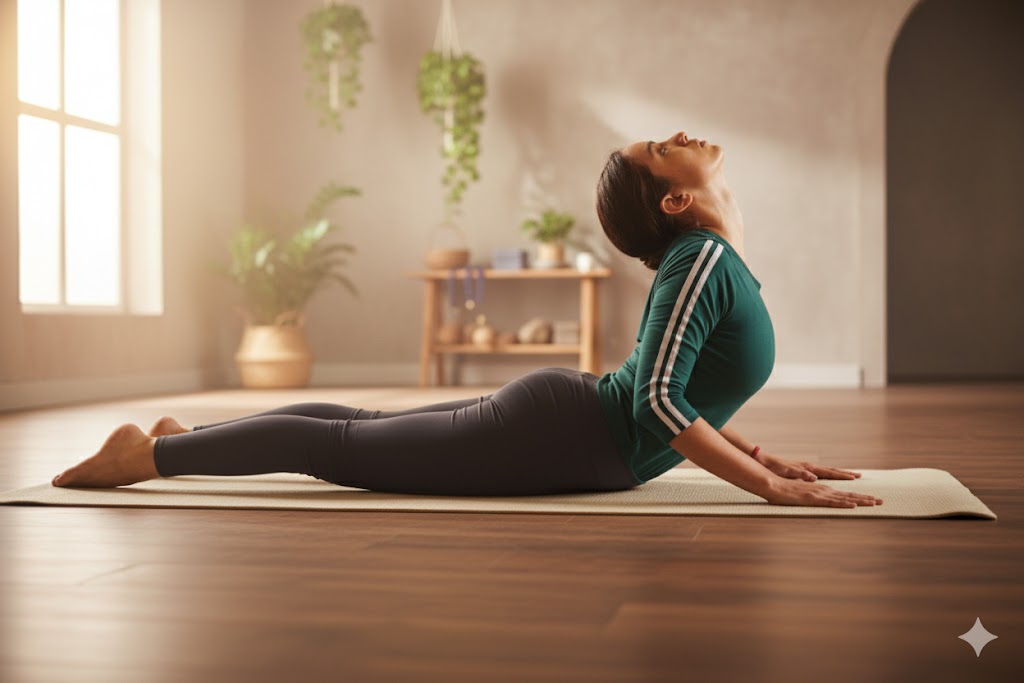
4. Bhujangasana (Cobra Pose) — Cervical Extension and Chest Opening
Bhujangasana is one of the most therapeutically relevant poses for cervical spondylosis because it directly addresses the fundamental postural imbalance underlying most cases — weakness of the posterior spinal muscles combined with tightness of the anterior chest and neck structures. The pose strengthens the extensor muscles of the cervical and thoracic spine — muscles that are chronically lengthened and weak in people with forward head posture — while simultaneously opening the chest and stretching the anterior neck.
Steps: Lie face down with the legs straight, feet together, soles facing upward. Place the palms flat on the floor below and slightly outside the shoulders. On an inhalation, slowly press the palms into the floor and lift the chest off the ground, keeping the elbows slightly bent rather than locking them straight. The navel should remain on or near the floor — this is a low Cobra rather than a high backbend. Allow the neck to follow the line of the spine — do not throw the head back aggressively. Hold for 15 to 30 seconds with steady nasal breathing. Exhale slowly to lower the chest back to the floor. Perform 3 to 5 repetitions. Modification for severe cervical cases: keep the neck neutral — looking straight down at the floor rather than extending the gaze forward — to reduce cervical extension pressure while still gaining the thoracic extension benefit.
5. Matsyasana (Fish Pose) — Cervical Traction and Throat Opening
Matsyasana creates gentle cervical traction — a stretching and decompression of the cervical intervertebral spaces — through its characteristic backward arch of the neck. When performed carefully with appropriate support, this decompressive action may provide temporary relief from the nerve root compression associated with cervical spondylosis. The pose also directly stretches the anterior neck muscles — sternocleidomastoid, scalenes and anterior neck flexors — which become chronically shortened in forward head posture.
Steps: Lie on the back with the legs extended. Slide both hands under the buttocks, palms facing downward. On an inhalation, press the elbows into the floor and lift the chest off the ground, allowing the crown of the head to rest lightly on the floor — creating a gentle arch of the neck. For spondylosis patients, always use a folded blanket or block under the head and upper back so the neck extension is minimal and fully supported. Hold for 15 to 30 seconds with gentle breathing. To release, press the elbows firmly into the floor and lift the head before lowering the chest — never drop the head abruptly. Perform 2 to 3 repetitions. If any tingling or numbness in the arms occurs, come out of the pose immediately.
6. Gomukhasana (Cow Face Pose) — Shoulder and Cervical Girdle Release
Gomukhasana is particularly valuable for the substantial proportion of cervical spondylosis patients who also develop restricted shoulder mobility or frozen shoulder syndrome — a common co-presentation driven by the same muscular imbalances that underlie the cervical condition. The pose creates a deep stretch of the posterior shoulder capsule, triceps, and lateral rotators of the shoulder on the raised arm side, while stretching the anterior shoulder and internal rotators on the lower arm side. This bilateral shoulder opening directly reduces the tension load on the cervical attachments of the shoulder girdle muscles.
Steps: Sit in Sukhasana or on a chair. Raise the right arm overhead and bend the elbow, allowing the right hand to drop toward the upper back. Bring the left arm behind the back from below, bending the elbow upward, and attempt to clasp the fingers of both hands behind the back. If the hands cannot meet, use a strap or folded towel between them. Keep the spine tall and the chin level — do not allow the head to drop forward or to the right. Hold for 30 to 60 seconds with slow breathing. Repeat on the opposite side, always ensuring equal time on both sides. Important: do not allow the head and neck to be pulled out of neutral position during this pose — the cervical spine should remain stacked and comfortable throughout.
7. Ardha Matsyendrasana (Half Spinal Twist) — Lateral Cervical Mobility
Rotational mobility of the cervical spine — the ability to turn the head comfortably to both sides — is one of the first functional capacities affected by cervical spondylosis and one of the most important for daily activities including driving, social interaction and occupational tasks. Ardha Matsyendrasana addresses this through a whole-spine rotation that begins at the lumbar spine and travels upward through the thoracic and into the cervical region — mobilising the entire rotational chain rather than forcing isolated neck turning.
Steps: Sit on the floor with both legs extended. Bend the right knee and place the right foot flat on the floor outside the left knee. Keeping the spine tall, inhale to lengthen, then exhale to rotate the torso to the right, placing the left elbow outside the right knee. Allow the rotation to travel gently up through the thoracic and into the lower cervical spine — turning the gaze gently over the right shoulder. For cervical spondylosis patients, keep the neck rotation minimal and comfortable — the therapeutic benefit comes from the thoracic rotation, not forcing the neck. Hold for 30 to 60 seconds with slow breathing. Repeat on the left side. Ensure equal time on both sides.
8. Shavasana (Corpse Pose) — Complete Cervical Relaxation
Shavasana is consistently underestimated by patients seeking active relief for cervical spondylosis — yet it addresses one of the most significant and underappreciated drivers of cervical pain: muscular hypertonicity. The chronic muscular tension that develops around the cervical spine in spondylosis — as muscles contract to protect and stabilise an unstable or painful joint — creates a self-perpetuating pain-spasm-pain cycle. Every episode of pain causes more muscular guarding, which causes more pain, which causes more guarding. Shavasana, practised with conscious relaxation techniques, breaks this cycle by activating the parasympathetic nervous system and directly reducing the muscular tension component of cervical pain.
Steps: Lie flat on the back with a thin pillow or folded blanket under the head and neck to maintain neutral cervical alignment — do not use a pillow so thick that it pushes the chin toward the chest. Allow the arms to rest 15 to 20 cm from the body, palms facing upward. Close the eyes. Systematically release tension from every body part — beginning at the feet, moving upward through the legs, pelvis, abdomen, chest, arms, shoulders, neck and face. Pay particular attention to the jaw, the tongue, the muscles around the eyes and the muscles at the base of the skull — these areas carry enormous unconscious tension in people with chronic neck pain. Hold for 15 to 20 minutes. When practised consistently at the end of each yoga session, Shavasana consolidates the benefits of the preceding poses and provides measurable relief from the nervous system contribution to cervical pain.
9. Surya Namaskar (Sun Salutation) — Modified Version Only
Surya Namaskar provides the most comprehensive full-body movement sequence available in yoga — engaging the entire kinetic chain from fingertips to toes in coordinated breath-movement integration. For cervical spondylosis patients, its value lies in building overall spinal health, improving cardiovascular fitness (which supports tissue healing), and addressing the full-body postural imbalances that contribute to cervical degeneration. However, the standard Surya Namaskar sequence includes neck extension in the Cobra position and neck dropping in the Downward Dog position — both of which require modification for spondylosis patients.
Modifications for cervical spondylosis: In the Cobra position (positions 7 and 8), keep the neck neutral — gaze straight down at the floor — rather than extending the head upward. In Downward Dog, allow the neck to hang in its natural position between the upper arms without forcing the head toward the floor. In the standing forward fold positions, bend the knees generously and keep the neck long rather than letting it drop with full gravity. Begin with 2 to 4 rounds daily and build gradually over weeks. During active flare-ups of cervical pain, pause Surya Namaskar and return to the gentler individual poses until the acute episode resolves.
10. Uttana Mandukasana (Stretched Up Frog Pose) — Cervical and Upper Back Relief
Uttana Mandukasana is particularly relevant for cervical spondylosis because it simultaneously addresses both the cervical spine and the shoulder girdle in a single, accessible posture. The position of the arms — folded behind the upper back — creates a powerful opening of the anterior chest and a gentle traction on the cervical attachments of the upper trapezius and levator scapulae muscles. This combination directly counteracts the forward-rolled shoulder, forward-head posture that is both a cause and a consequence of cervical spondylosis in the Indian screen-work population.
Steps: Sit in Vajrasana (kneeling on the heels). Spread both knees wide apart while the toes remain touching. Raise the right arm, fold it from the elbow, and take it backward from above the right shoulder — placing the palm between the shoulder blades. Now fold the left arm similarly from below, bringing the left palm upward to meet the right. Maintain the position with the spine tall and the chin level. Breathe slowly and steadily, feeling the chest open and the upper back muscles engage gently. Hold for 30 to 60 seconds. To release, remove the left arm first, then the right. Perform 3 to 5 repetitions. This pose is the same posture that holds the top position on gyanunlimited.com for cervical spondylosis — Uttana Mandukasana — because it delivers among the most direct and consistently reported benefits for this condition of all yoga poses.
🌬️ Pranayama for Cervical Spondylosis
Pranayama addresses cervical spondylosis through two primary mechanisms: reducing the stress-driven muscular tension that worsens cervical pain, and improving oxygenation of the intervertebral discs and surrounding tissues. The cervical intervertebral discs are avascular — they receive their nutrition through diffusion, which depends on movement and pressure changes. Deep, rhythmic breathing creates a pumping action through the thoracic and cervical spine that improves this disc nutrition mechanism.
Recommended Pranayama for Cervical Spondylosis:
• Nadi Shodhana (Alternate Nostril Breathing): Balances the nervous system, reduces stress-related muscular tension — 10 to 15 minutes daily
• Bhramari (Humming Bee Breath): The vibration created by the humming sound resonates through the cervical vertebrae and cranial base — shown to reduce pain perception through vagal activation
• Ujjayi (Ocean Breath): Slows and deepens breathing — creates internal warmth and relaxation of cervical musculature
Avoid: Kapalabhati and Bhastrika during acute cervical pain episodes — the rapid movements may jar the cervical spine and worsen symptoms
Ayurveda for Cervical Spondylosis — Greeva Sandhi Vata
In Ayurveda, cervical spondylosis is understood within the framework of Greeva Sandhi Vata (degenerative joint disease of the neck) or more specifically Manyastambha (stiffness of the neck region). It is classified as a Vata disorder — the accumulated Vata dosha dries and erodes the cartilaginous and bony structures of the cervical spine over time, causing the degenerative changes that modern imaging confirms. Treatment is directed at pacifying Vata, nourishing the Asthi dhatu (bone tissue) and Majja dhatu (nerve tissue), and clearing accumulated Ama (metabolic waste) from the cervical channels (Srotas).
Key Ayurvedic Herbs for Cervical Spondylosis
Ashwagandha (Withania somnifera): Ashwagandha is classified in Ayurveda as Balya (strength-promoting) and Vata-shamaka (Vata-pacifying) — both properties directly relevant to cervical spondylosis management. Its active withanolides have documented anti-inflammatory and adaptogenic properties. Research published in the Journal of the International Society of Sports Nutrition confirmed Ashwagandha’s efficacy in reducing pain and inflammation. For cervical spondylosis, Ashwagandha Churna (1 to 2 teaspoons) with warm milk at bedtime is the classical prescription — supporting both the degenerative process and the stress-driven muscular tension component.
Shallaki (Boswellia serrata): Shallaki is among the most clinically researched Ayurvedic herbs for osteoarthritis and degenerative joint diseases. A randomised controlled trial published in Phytomedicine found that Boswellia extract significantly reduced pain and improved function in knee osteoarthritis — findings researchers believe extend to other degenerative joint conditions including cervical spondylosis. Its active boswellic acids specifically inhibit 5-lipoxygenase, the enzyme responsible for inflammatory leukotriene synthesis in joint tissues. Available as Shallaki capsules or tablets from licensed Ayurvedic pharmacies.
Guggulu (Commiphora wightii): Guggulu is a classical Ayurvedic resin with potent Vata-pacifying and anti-inflammatory properties. Yogaraja Guggulu — a compound formulation containing guggulu with 28 herbal ingredients — is among the most widely prescribed classical Ayurvedic preparations for cervical spondylosis by registered Ayurvedic physicians across India. It supports reduction of joint inflammation, improvement of local circulation and tissue nourishment in the cervical region.
Nirgundi (Vitex negundo): Nirgundi leaves and their preparations are specifically recommended in Ayurvedic practice for cervical and lumbar spine disorders. The plant has documented anti-inflammatory, analgesic and muscle-relaxant properties. A steam fomentation (Nadi Sweda) using Nirgundi leaves boiled in water — with the steam directed to the neck and shoulders — is a classical and widely practised Ayurvedic local treatment for cervical spondylosis that provides direct relief from stiffness and pain.
Ayurvedic Therapies for Cervical Spondylosis
Greeva Basti: This is the most specific Ayurvedic therapy for cervical spondylosis. A ring of black gram dough is constructed around the neck region, filled with warm medicated oil — typically Mahanarayana Taila or Kshirabala Taila — and maintained at a comfortable temperature for 30 to 45 minutes. The oil penetrates the cervical tissues, nourishes the intervertebral discs and surrounding structures, reduces Vata-driven dryness and degeneration, and provides significant relief from cervical stiffness and pain. Multiple clinical studies from Ayurvedic research institutions have documented Greeva Basti’s effectiveness for cervical spondylosis. It is available at licensed Panchakarma centres across India.
Abhyanga (Medicated Oil Massage): Regular Abhyanga of the neck and upper back with warm sesame oil or Mahanarayana Taila reduces muscular tension, improves local circulation, and provides the Snehana (oleation) that classical Ayurveda prescribes as the foundation of Vata-disorder treatment. Self-Abhyanga of the neck and shoulders — 10 to 15 minutes of warm oil massage before the morning bath — is an accessible and effective daily practice for cervical spondylosis management.
Naturopathy for Cervical Spondylosis
Naturopathy approaches cervical spondylosis through its emphasis on natural physical agents — heat, cold, water, rest and corrective posture — to reduce inflammation, improve circulation and restore normal tissue function without pharmaceutical intervention.
Hot and Cold Hydrotherapy: Alternating application of heat and cold to the cervical region is a well-established naturopathic treatment for cervical pain. A hot fomentation (warm towel or heating pad at a comfortable temperature, not hot enough to burn) applied for 3 minutes, followed immediately by a cold pack for 1 minute, repeated 3 to 4 times — creates alternating vasodilation and vasoconstriction that dramatically improves local circulation and reduces inflammatory mediator accumulation. This contrast hydrotherapy sequence can be safely self-administered at home once or twice daily during periods of heightened cervical pain.
Posture Correction and Ergonomics: Naturopathy places particular emphasis on removing the cause of disease — and for cervical spondylosis, correcting the forward head posture and poor ergonomics that drive the condition is as important as any therapy. The naturopathic prescription includes: screen at eye level, back supported at 90 to 110 degrees, chair height adjusted so feet are flat on the floor, and a break of 5 minutes every 45 minutes of desk work with neck movements and shoulder rolls during each break. These simple ergonomic corrections, consistently applied, directly slow the progression of cervical degeneration.
Mud Pack Therapy: Application of cool mud packs to the neck and shoulders is used at naturopathy centres for its anti-inflammatory and cooling effect on the inflamed cervical tissues. The absorbent quality of therapeutic mud draws heat from inflamed tissues, reducing oedema and providing a sustained cooling action that analgesic creams cannot match in duration.
Unani Medicine for Cervical Spondylosis — Waja-ul-Mafasil
In Unani medicine, cervical spondylosis and neck pain fall within the category of Waja-ul-Mafasil (joint pain) with specific involvement of the cervical region. It is understood as a Balgham (phlegm) and Riyah (wind/gas) disorder — corresponding broadly to Kapha and Vata imbalance in Ayurvedic terms — causing deposition of abnormal humours in the cervical joint spaces, leading to degeneration, pain and stiffness.
Ilaj-bil-Tadbir (Regimental Therapy): Unani regimental therapies for cervical spondylosis include Dalak (massage with medicated oils), Hammam (medicated steam bath to the cervical region) and Riyazat (prescribed physical exercise) — the Unani framework for what Ayurveda would call Abhyanga and Nadi Sweda, confirming the classical Indian multi-system consensus on the therapeutic value of heat, oil and movement for this condition.
Siddha Medicine for Cervical Spondylosis
In Siddha medicine, cervical spondylosis is understood as a Vatham-dominant condition — the Vatham (corresponding to Vata) governing movement, dryness and the nervous system becoming vitiated and causing degeneration of the cervical structures. Treatment is directed at balancing Vatham through internal Siddha herbal preparations, external oil applications and specific dietary prescriptions.
Classical Siddha preparations including Nilavembu Kudineer have been used traditionally for joint and musculoskeletal conditions in Tamil Nadu’s Siddha clinical tradition. Thokkanam — Siddha’s classical manual therapy — applied by a qualified Siddha therapist to the neck and shoulder region provides direct muscular release and improved circulation to the affected tissues. Government Siddha hospitals across Tamil Nadu provide Thokkanam as part of their clinical services for musculoskeletal conditions including cervical spondylosis.
Homeopathy for Cervical Spondylosis
Homeopathy offers individualised constitutional treatment for cervical spondylosis — the specific remedy chosen depends on the complete symptom picture including the character of the pain, its aggravating and ameliorating factors, the patient’s constitution, and associated psychological features. The following remedies are commonly used in clinical homeopathic practice for cervical spondylosis presentations.
Key Homeopathic Medicines for Cervical Spondylosis:
• Rhus Toxicodendron: First choice for cervical stiffness that is dramatically worse on first movement and better after continued movement — the classic “rusty gate” symptom. Worse in cold damp weather, better for warmth. Particularly relevant for morning stiffness that improves after the first 15 to 20 minutes of activity
• Bryonia Alba: For cervical pain that is worse on any movement — the patient wants to lie completely still. Worse for turning the head, better for firm pressure. Opposite picture to Rhus Tox
• Calcarea Phosphorica: For cervical spondylosis with neck pain in school students and young adults — particularly relevant in the current Indian context of young professionals with early-onset spondylosis. Associated with fatigue, anaemia and bone weakness
• Hypericum Perforatum: Specifically indicated when cervical spondylosis involves nerve compression with shooting, burning or electric-shock-like pains radiating down the arms — nerve pain is a distinguishing feature
• Kalmia Latifolia: For cervical radiculopathy with pain radiating from the neck downward into the arms, chest and hands — typically right-sided and associated with numbness and tingling
All homeopathic remedies for cervical spondylosis should be prescribed by a qualified BHMS practitioner after complete case assessment.
Diet for Cervical Spondylosis — Indian Context
Diet plays a supporting role in cervical spondylosis management — primarily by addressing the nutritional deficiencies (particularly calcium, vitamin D, magnesium and collagen precursors) that accelerate intervertebral disc and bone degeneration, and by reducing the inflammatory dietary patterns that worsen pain and tissue inflammation.
✅ Best Foods for Cervical Spondylosis in Indian Diet:
• Til (Sesame seeds): Among the richest plant sources of calcium — 1 tablespoon provides approximately 88mg calcium. Til chikki, til laddoo and til added to dal and roti are practical daily sources
• Ragi (Finger Millet): Highest calcium content of any cereal — 344mg per 100g. Ragi roti, ragi porridge and ragi ladoo should be regular dietary inclusions for spondylosis patients
• Moringa (Drumstick leaves): Exceptionally rich in calcium, magnesium, vitamin C and anti-inflammatory compounds. Fresh moringa leaves in dal or sambhar, or moringa powder added to water, is an excellent daily supplement
• Amla (Indian Gooseberry): The richest natural source of vitamin C — essential for collagen synthesis in intervertebral discs and cartilage. Daily consumption of fresh amla or amla powder supports disc integrity
• Walnuts and flaxseeds (Akhrot and Alsi): Rich in omega-3 fatty acids with documented anti-inflammatory properties relevant to cervical pain reduction
• Turmeric (Haldi) with black pepper: Curcumin’s anti-inflammatory properties are enhanced 20-fold by piperine in black pepper. Haldi doodh (turmeric milk) with a pinch of black pepper before bed is a practical and evidence-supported daily anti-inflammatory practice
Foods to Limit for Cervical Spondylosis:
• Refined carbohydrates (maida, white sugar) — promote systemic inflammation
• Excessive cold foods and drinks — aggravate Vata and may worsen cervical stiffness according to both Ayurvedic and clinical observation
• Processed and packaged foods — high sodium promotes water retention and inflammation
• Red meat in excess — arachidonic acid promotes inflammatory prostaglandins
• Alcohol — impairs calcium absorption and worsens nerve inflammation
Lifestyle Changes for Cervical Spondylosis — The Daily Practice
Ergonomic correction: This is the single most important non-therapeutic intervention. Raise your computer screen to eye level using a stand or stack of books — this alone eliminates the constant forward head posture that is the primary driver of cervical degeneration in desk workers. Use a supportive chair with proper lumbar and neck support. If working on a phone or tablet, bring the device to face level rather than dropping the head to look at it. Set a reminder every 45 minutes to stand, move and perform 2 to 3 minutes of shoulder and neck movements.
Sleep posture: Use a cervical pillow that supports the natural cervical lordosis — neither too high (which pushes the neck into forward flexion) nor too flat (which drops the neck into extension). Sleep on the back or side — never on the stomach, which rotates the cervical spine to one side and compresses the cervical facet joints throughout the night. A rolled towel inside the pillowcase can serve as an economical cervical support.
Stress management: Chronic psychological stress causes persistent contraction of the trapezius and levator scapulae — the muscles most directly implicated in cervical pain. Yoga, meditation, breathing practices and adequate sleep all directly reduce this stress-driven muscular component of cervical spondylosis.
Frequently Asked Questions About Cervical Spondylosis
Q: Can yoga cure cervical spondylosis completely?
A: Cervical spondylosis is a degenerative condition — the structural changes in the vertebrae and discs are not reversible through yoga or any other conservative treatment. What yoga can meaningfully achieve is significant reduction in pain, improvement in range of motion, strengthening of the supporting musculature, improvement in posture, and slowing of further degeneration. Many patients achieve excellent functional outcomes and symptom control through consistent yoga practice, even though the underlying degeneration on imaging remains. Complete cure of structural degeneration is not a realistic expectation from yoga — excellent functional recovery is.
Q: Which yoga poses should be strictly avoided in cervical spondylosis?
A: Strictly avoid circular neck rolling (Chakrasana of the neck), Sirsasana (headstand), Sarvangasana without proper support and experience, any pose involving forceful neck extension or compression, and rapid or jerky neck movements. In Surya Namaskar, modify the Cobra and Downward Dog positions as described above. Avoid all poses that produce or worsen arm tingling or numbness — this indicates nerve root involvement requiring medical evaluation.
Q: Is cervical spondylosis more common in people who use phones a lot?
A: Yes — the condition colloquially called “text neck” or “smartphone neck” is now a well-recognised clinical entity. Looking down at a phone held at waist level increases the effective load on the cervical spine from approximately 5 kg (the normal head weight) to 27 kg at 60 degrees of forward flexion — equivalent to placing five times the head’s weight on the cervical spine continuously. Indians who spend 6 to 8 hours daily on smartphones with the head dropped forward are dramatically accelerating the rate of cervical degeneration. Holding the phone at face level is a simple, immediately effective intervention.
Q: What is the difference between cervical spondylosis and cervical spondylitis?
A: Cervical spondylosis is a degenerative condition — age-related wear and tear of the cervical discs and joints, characterised by progressive degeneration without systemic inflammation. Cervical spondylitis refers to inflammatory arthritis of the cervical spine — typically part of a systemic inflammatory condition like ankylosing spondylitis or rheumatoid arthritis. The distinction is important because the two conditions require different management approaches. If blood inflammatory markers (ESR, CRP) are elevated alongside cervical symptoms, inflammatory spondylitis should be considered.
Q: Can Greeva Basti be done at home?
A: Greeva Basti as a formal Panchakarma therapy — with the dough ring, temperature-controlled medicated oil and proper technique — requires a trained Ayurvedic therapist and should only be done at a licensed Panchakarma centre. However, a simplified home version — warm sesame oil or Mahanarayana Taila applied generously to the neck and upper shoulders, covered with a warm towel for 20 to 30 minutes — provides a meaningful portion of the benefit in an accessible, safe home format.
Q: Should I wear a cervical collar for cervical spondylosis?
A: Soft cervical collars may provide temporary pain relief during acute flare-ups by reducing neck movement and muscle strain. However, prolonged collar use is counterproductive — it weakens the cervical musculature through disuse, which worsens the underlying instability driving spondylosis. Most orthopaedic and physiotherapy guidelines recommend collar use only for short periods during acute exacerbations, with active exercise and yoga being the preferred long-term approach. Discuss collar use with your treating doctor rather than self-prescribing prolonged collar wear.
Q: At what age does cervical spondylosis typically begin in India?
A: Radiological evidence of early cervical degeneration can begin as early as the late 20s in individuals with significant screen-time exposure and poor posture. Symptomatic cervical spondylosis — causing actual pain and functional limitation — most commonly presents in the 35 to 55 age range in India, though cases in the 25 to 35 age group are increasingly common in IT workers, students and professionals with heavy screen use. Above 60 years, over 85% of individuals show significant cervical degeneration on imaging, though not all are symptomatic.
Q: Does Vitamin D deficiency worsen cervical spondylosis?
A: Yes — vitamin D deficiency, which is extremely prevalent in India despite abundant sunlight (due to indoor lifestyles, dark skin with lower cutaneous synthesis, and low dietary vitamin D), directly impairs calcium absorption, weakens bone density and accelerates degenerative joint disease. Multiple studies have found associations between vitamin D deficiency and severity of osteoarthritis and degenerative spine disease. Getting a serum vitamin D test and correcting deficiency — through safe sun exposure and supplementation if needed, under medical guidance — is an important supportive measure for all cervical spondylosis patients.
📌 Related Articles You May Find Helpful:
• Uttana Mandukasana — Steps, Benefits and Precautions for Cervical Health
• Hastottanasana — Steps, Benefits and Precautions
• High Blood Pressure — Natural Management Through AYUSH Systems
• Ashwagandha — Health Benefits and Medicinal Uses in Ayurveda
• Yastikasana (Stick Pose) — Steps, Benefits and Precautions
• Yoga and Breathing Techniques for Asthma Management




Information is highly beneficial
Highly implementable good info
Thanks A Lot
Really Most Helped Information
This article will help millions who are suffering from Cervical Spondylosis. If practiced in right earnest, the yoga poses helps a lot.
Good information and useful to so many sufferers of back pain, neck pain etc,
Thanks a lot.
it is very useful for who is suffering from Cervical spondylosis & do practice because “practice makes a man ferfect” so need to be practice until get the expected result.
VERY FRUITFUL INFO SINCE MYSELF IS ALSO SUFFERING FROM THE DISEASE .MUCH BENEFICIAL ARE THE YOGAS FOR PAIN RELIEF. THANKS FOR THE GOOD INFO,
very exiting to get cure , who suffers from cervical spondylosis
thanks lot for this healty tips advise
Is this problem genetic of it is caused by the lifestyle you live??
I am suffering for a long time. As me eager to know….Would pl. give me the advice to relief from cervical spondelysis along with vertigo?
nice write up!
My spine has become stiff due to rheumatoid arthritis and I am also a patient od diabetes. So please suggest me the asanas of Yoga which may be performed by me. I am now 58yrs, suggest me accordingly. Thanks & regards
You need Yoga therapy instead of yoga. Kindly consult a good yoga therapist to know the finer technique for better result. The mentioned yoga poses can also be tried but in presence of yoga expert.