🔬 What Is Hastottanasana — Sanskrit Meaning and Classical Background
Hastottanasana is a compound Sanskrit name built from three components: Hasta meaning arms or hands, Uttana meaning stretched upward or intensely extended, and Asana meaning posture or seat. Together they describe precisely what this posture does — it extends the arms fully upward and then bends laterally from the waist, creating a comprehensive stretch of the entire side body.
The posture is also known by several alternate names across different yoga traditions. Urdhva Hastasana (Upward Salute) refers to the arm-raising component when practised without the lateral bend. Tiryaka Tadasana (Swaying Palm Tree Pose) is the name used in many Hatha yoga traditions for the side-bending variation. In the Surya Namaskar (Sun Salutation) sequence, the upward arm extension at position 2 is Hasta Uttanasana — making this one of the most practised yoga positions in the world, even if people do not always recognise it by name.
• Hastottanasana — most common name in Indian physical education and school yoga curricula
• Urdhva Hastasana — Upward Salute — used in Iyengar and Vinyasa traditions
• Hasta Uttanasana — used in Surya Namaskar sequences (position 2 and 11)
• Tiryaka Tadasana — Swaying Palm Tree Pose — emphasises the lateral bend variation
• Up-Stretched Arms Posture — common English description used in Indian textbooks
In the classical Hatha yoga tradition, standing postures like Hastottanasana serve as preparatory and foundational asanas — they warm up the spine, open the lateral body, improve the connection between the feet and the hands through the entire kinetic chain, and prepare the practitioner for deeper and more demanding postures. The simplicity of Hastottanasana is intentional — it teaches the practitioner fundamental principles of alignment, breath coordination and lateral extension that apply throughout the entire yoga practice.
🧘 How to Do Hastottanasana — Complete Step-by-Step Method
There are two primary forms of Hastottanasana that are most widely practised. The first is the pure upward extension — arms raised overhead. The second and more therapeutically significant form adds a lateral side bend. Both are described here in complete detail.
Form 1 — Hastottanasana with Upward Extension Only
Starting position: Stand in Tadasana (Mountain Pose) — feet together or hip-width apart depending on your balance, spine tall, shoulders relaxed, arms hanging naturally by the sides, gaze forward and level. Take two or three slow nasal breaths to settle into the standing position before beginning.
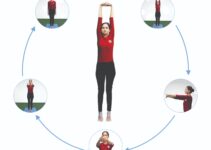
Step 1: On a slow, deep inhalation, begin to raise both arms forward and upward in a wide sweeping arc — as if drawing a circle with your fingertips. Keep the elbows straight throughout the movement. The arms rise from beside the hips, forward past the face, and overhead until the arms are fully extended upward with the biceps beside or slightly behind the ears.
Step 2: At the top of the movement, interlace the fingers and turn the palms to face upward toward the ceiling. Press the palms gently upward as if pushing against a low ceiling, lengthening the entire spine from the tailbone to the fingertips. Feel the stretch travel from the arches of the feet through the legs, torso, shoulders and out through the extended arms.
Step 3: Lift onto the toes (this is optional — beginners can keep the feet flat). Rising onto the toes intensifies the full-body stretch and challenges balance simultaneously. Keep the core lightly engaged, the lower back long rather than compressed, and continue breathing slowly through the nose.
Step 4: Hold the position for 15 to 30 seconds with steady nasal breathing — inhaling to lengthen, exhaling to ground. On each inhale, create a little more length from tailbone to fingertips. On each exhale, press the feet firmly into the floor and engage the inner thighs gently.
Step 5: To release, on an exhalation lower the heels back to the floor if raised, unlace the fingers, and sweep the arms back down in a controlled arc to the starting position. Do not drop the arms — lower them with the same control and breath awareness used to raise them. Take one full breath in Tadasana before the next repetition.
Form 2 — Hastottanasana with Lateral Side Bend (The Therapeutic Form)
Starting position: Begin in the same Tadasana as Form 1. Feet together or hip-width apart, spine tall, arms at sides. Establish a steady nasal breath before beginning.
Step 1: On a deep inhalation, raise both arms overhead as described in Form 1 — sweeping forward and up until fully extended, fingers interlaced, palms facing upward.
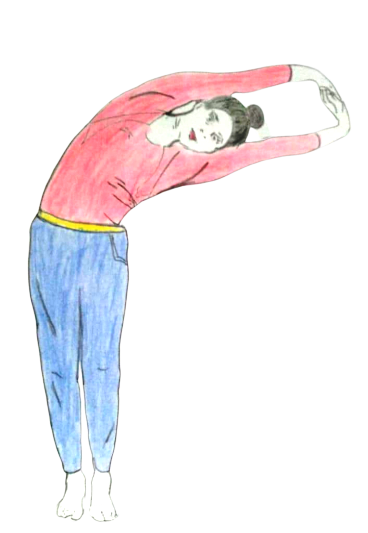
Step 2: On the next exhalation, slowly bend the entire upper body to the right side from the waist — not the hips. The key instruction here is to keep the hips square and facing forward throughout the side bend. Only the torso above the waist moves. The right side compresses and the left side stretches. Allow the head to move with the arms — do not strain the neck. The left arm extends further overhead as the body tilts right, creating maximum stretch along the entire left lateral body.
Step 3: In the side-bend position, hold for 15 to 30 seconds. Take slow nasal breaths — on each inhalation feel the left ribs expand and the left side lengthen. On each exhalation feel the body settle a little deeper into the bend without force. Keep both feet firmly grounded — the tendency is for the left heel to lift, which should be consciously resisted.
Step 4: On an inhalation, slowly return to centre — arms overhead, spine tall. Take one full breath at centre before bending to the left side on the next exhalation.
Step 5: Repeat the lateral bend to the left side — this time the right side stretches and the left side compresses. Hold for the same duration on both sides to ensure balanced development.
Step 6: Return to centre on an inhalation, then lower the arms on an exhalation, returning to Tadasana. This completes one full round. Practise 3 to 5 rounds per session.
• Hips stay square: The side bend happens at the waist, not the hip. Both hip bones should remain level and facing forward
• Both feet grounded: The foot on the stretching side tends to lift — press it firmly into the floor throughout
• Elbows straight: Bent elbows reduce the effectiveness of the lateral stretch significantly
• Head moves with arms: Do not tilt the head independently — it should move naturally with the arc of the torso
• Core lightly engaged: This protects the lower back and prevents excessive lumbar compression in the bend
• Breath continuous: Never hold the breath in the side-bend position — this increases intra-thoracic pressure unnecessarily
• Equal time both sides: Always hold each side for the same duration to maintain spinal symmetry
🔬 Health Benefits of Hastottanasana — Detailed and Evidence-Informed
The health benefits of Hastottanasana operate through multiple physiological pathways. What appears to be a simple stretch is, when examined closely, a comprehensive intervention for spinal health, organ stimulation, respiratory improvement and metabolic support.
1. Comprehensive Spinal Mobility and Health
Hastottanasana provides lateral spinal flexion — a movement that is rarely performed in daily life. Most people move their spines in the sagittal plane (forward and backward bending) through activities like sitting, reaching and lifting. Lateral spinal movement is almost entirely absent from modern daily activity patterns. This absence contributes to stiffness and asymmetry in the spinal muscles and intervertebral joints.
The side-bend action in Hastottanasana stretches the quadratus lumborum (the deep lateral back muscle), the intercostal muscles between the ribs, the oblique abdominal muscles, and the lateral neck muscles — all in one coordinated movement. Research on yoga and spinal disorders published in a 2024 qualitative study (NCBI PMC) found that yoga postures involving spinal extension and lateral movement provide significant and sustainable contributions to spinal health and postural quality. Regular practice of Hastottanasana elongates each vertebra of the spine, decompresses the intervertebral discs on the stretching side, and progressively restores lateral flexibility that desk-based modern lifestyles progressively erode.
2. Kidney Circulation and Detoxification Support
One of the most scientifically interesting benefits of Hastottanasana — and one that sets it apart from many other standing postures — is its documented effect on kidney circulation. A review by Venkatesh et al. (2022), cited in multiple clinical resources including PharmEasy’s medical advisory content, stated that Hasta Uttanasana as part of the Surya Namaskar sequence helps in contracting and expanding the muscles surrounding the kidneys, which increases blood flow to these organs. Improved renal circulation supports the kidneys’ filtration function — their ability to flush metabolic waste, excess sodium and toxins from the bloodstream.
The mechanism is logical: the lateral bend in Hastottanasana alternately compresses and stretches the lumbar region where the kidneys are located. On the side of compression, the kidney receives a gentle massage that supports local venous drainage. On the side of extension, the kidney receives a fresh rush of arterial blood. Repeating this on both sides provides a bilateral pumping action that may meaningfully support kidney circulation when practised regularly as part of a daily yoga routine.
3. Digestive Organ Stimulation
The upward extension of the arms in Hastottanasana creates a strong stretch of the abdominal wall — the rectus abdominis, internal and external obliques, and the transverse abdominis are all lengthened under the pull of the extended arms. This stretching action compresses and then releases the digestive organs — including the stomach, liver, pancreas, small intestine and large intestine — in a manner that stimulates digestive enzyme secretion, improves intestinal peristalsis (the wave-like movement that moves food through the gut) and reduces the bloating and sluggishness associated with digestive inactivity.
Classical yoga texts consistently list improved digestion and relief from constipation among the primary benefits of Hastottanasana. The physiological mechanism — abdominal muscle stretch leading to organ compression and release — provides a credible scientific framework for this traditionally documented benefit. When combined with deep nasal breathing during the posture, the diaphragm adds further massage to the abdominal organs from above with every breath cycle.
4. Lateral Fat Reduction at the Waist
Hastottanasana is specifically recognised in Indian physical education and traditional yoga texts as beneficial for reducing lateral fat deposits at the waist — the “love handles” or oblique fat that accumulates with sedentary living and excess caloric intake. The mechanism operates through the intensive engagement of the oblique abdominal muscles during the side bend. These muscles — which run diagonally along the sides of the abdomen — are among the most difficult to engage effectively with conventional exercises. The lateral bend of Hastottanasana creates sustained isometric and isotonic contraction of these muscles, improving their tone and metabolic activity over time.
Research on Urdhwa Hastottanasana specifically documents waist-slimming as a benefit when the posture is practised regularly with adequate repetitions (Yoga2All research summary). While spot reduction of fat is not physiologically possible in an absolute sense, improving the muscular tone and metabolic activity of a specific region through targeted exercise does support regional fat metabolism over time — particularly when combined with appropriate dietary changes.
5. Chest Opening and Respiratory Improvement
The upward arm extension in Hastottanasana opens the chest cavity by lifting the rib cage, drawing the shoulders back and away from the ears, and creating space between the ribs for full lung expansion. This chest-opening action directly increases tidal volume — the amount of air drawn into the lungs with each breath — and improves the elasticity of the intercostal muscles that support breathing mechanics. Research on yoga and respiratory health consistently documents improved lung capacity and respiratory efficiency with regular practice of chest-opening postures.
For people who spend long hours sitting in a forward-bent posture — students, desk workers, drivers — the chest becomes habitually compressed and the breathing becomes shallow and restricted. Hastottanasana counteracts this postural pattern directly by training the body to maintain an open chest and elevated rib cage. With consistent practice, this improved chest position carries over into daily sitting posture, improving breathing quality throughout the day — not just during yoga practice.
6. Shoulder and Upper Body Strengthening
Maintaining the arms in full overhead extension — particularly with interlaced fingers and upward-pressing palms — requires sustained activation of the deltoid muscles, rotator cuff, trapezius and serratus anterior. Holding this position for 20 to 30 seconds per repetition across multiple rounds builds functional shoulder strength and improves shoulder joint stability. The upward pressing action specifically strengthens the often-underused lower trapezius and serratus anterior — muscles critical for maintaining healthy shoulder mechanics and preventing the rounded-shoulder posture that causes cervical and thoracic discomfort.
7. Balance and Proprioception Training
When Hastottanasana is practised with the toes-raised variation — rising onto the balls of the feet — it becomes a significant balance challenge. The narrow base of support (the balls of the feet) combined with the high centre of gravity (arms fully extended overhead) requires precise activation of the ankle stabilisers, calf muscles, inner thighs and core. Regular practice of this variation improves proprioception — the body’s sense of its own position in space — which has direct benefits for fall prevention, sports performance and overall coordination. Even the standard flat-footed version improves postural awareness by training the practitioner to maintain a long, aligned spine while moving the upper body.
8. Stress Reduction and Mental Clarity
The upward extension of the arms in Hastottanasana is psychologically expansive — it is the opposite of the inward collapse associated with stress, fatigue and low mood. Research on posture and psychology has documented that adopting expansive, upright postures influences mood, confidence and stress perception. The coordination of movement with slow nasal breathing in Hastottanasana activates the parasympathetic nervous system, reduces cortisol levels and promotes the sense of mental clarity and calm that characterises a well-practised yoga session. Including Hastottanasana in a morning yoga routine sets a physiologically and psychologically positive tone for the day.
📋 Hastottanasana Variations — From Beginner to Advanced
Variation 1 — Chair-Supported Hastottanasana (For Elderly and Beginners)
Stand behind a sturdy chair and hold the back of the chair with one hand for support. Raise the free arm overhead and perform the lateral bend toward the supported side, allowing the chair to provide stability throughout the movement. This variation eliminates the balance challenge while preserving the full benefit of the lateral spinal stretch. It is ideal for older adults, for those recovering from balance disorders, and for true beginners who find standing balance challenging.
Variation 2 — Wall-Supported Hastottanasana
Stand with the back against a wall, feet about 15 cm from the wall. Raise the arms overhead and perform the lateral bend while keeping the back body in contact with the wall. The wall provides immediate feedback — if the hips shift to one side or the body rotates instead of purely bending laterally, contact with the wall is lost. This makes the wall-supported variation an excellent teaching and self-correction tool for practitioners who want to ensure their alignment is precise.
Variation 3 — Hastottanasana with Toe-Rise (Intermediate)
After raising the arms overhead and interlacing the fingers, rise onto the toes before performing the side bend. Maintaining the toe-rise through the lateral bend significantly increases the challenge to balance, calf strength and core stability. This variation is used in physical education contexts and in intermediate yoga classes to develop the full potential of the posture beyond the basic form.
Variation 4 — Dynamic Flowing Hastottanasana
Rather than holding the side-bend position statically, move dynamically — inhaling to centre, exhaling to bend right, inhaling to centre, exhaling to bend left — in a continuous flowing rhythm. This dynamic variation is used as a warm-up for the spine and is particularly effective for reducing morning stiffness in the lumbar and thoracic spine. It is a common inclusion in Pawanmuktasana series and preparatory yoga sequences in the tradition of Bihar School of Yoga.
🌿 Hastottanasana in Ayurveda and Traditional Yoga — The Deeper Significance
In Ayurveda, the lateral side-bending action of Hastottanasana is understood to stimulate and balance the energy channels (Nadis) that run along the lateral body — particularly the Ida and Pingala Nadis that represent the lunar and solar energy channels in yogic anatomy. The alternating compression and extension of the left and right sides of the body is believed to support the balanced flow of Prana (vital energy) through these channels, reducing the dominance of one side over the other — which in Ayurvedic understanding contributes to dosha imbalance and chronic health conditions.
From the Ayurvedic perspective of organ health, the lateral compression of the liver (right side bend) and spleen (left side bend) supports the digestive and immune functions of these organs respectively. The liver, which in Ayurveda is the seat of Pitta transformation, benefits from the gentle massaging action of the right lateral bend — particularly relevant for individuals with Pitta-type digestive complaints including heartburn, liver congestion and inflammatory digestive conditions.
Hastottanasana occupies position 2 (and its mirror at position 11) in the classical 12-step Surya Namaskar sequence. In this context it serves as the first active movement of the sequence — the upward arm extension that follows Pranamasana (Prayer Pose). Its role is to open the chest, stretch the spine and establish the coordinated breath-movement relationship that sustains the entire Surya Namaskar sequence. Practised as part of 12 rounds of Surya Namaskar, Hastottanasana is therefore performed 24 times — making it one of the most frequently repeated asanas in any yoga practice that includes Sun Salutations.
🩺 Conditions Hastottanasana May Support
| Condition | How Hastottanasana Helps | Caution |
|---|---|---|
| Constipation | Abdominal stretch stimulates intestinal peristalsis | Practise on empty stomach |
| Kidney health support | Improves renal blood circulation | Not a replacement for medical treatment |
| Lateral waist fat | Engages oblique muscles directly | Must combine with dietary changes |
| Spinal stiffness | Restores lateral spinal mobility | Avoid with acute disc herniation |
| Shallow breathing | Opens chest and intercostal spaces | Use gentle form for respiratory conditions |
| Postural roundedness | Trains upright spinal position | Wall-supported variation recommended |
| Shoulder stiffness | Full overhead extension improves shoulder mobility | Avoid with rotator cuff injury |
⚠️ Precautions and Contraindications — Who Should Be Careful
• Acute lower back pain or disc herniation: The lateral bend creates compressive forces on the lumbar discs — avoid during acute episodes and resume only after recovery with expert guidance
• Pregnancy (second and third trimester): The deep lateral bend and toe-rise variation should be avoided. The basic arm-raise without lateral bend may be practised with wall support in early pregnancy under guidance
• Severe dizziness or vertigo: The combination of arm elevation and potential toe-rise can worsen vestibular symptoms
• Varicose veins: The toe-rise variation increases venous pressure in the legs — stick to the flat-footed form
• Recent shoulder surgery or rotator cuff injury: Full overhead arm extension places significant load on the shoulder joint — avoid until cleared by a physiotherapist
• Severe headache or migraine: Do not practise during active headache — the arm elevation and breath changes may worsen symptoms
• High blood pressure (uncontrolled): Arm elevation above the heart level temporarily increases blood pressure — those with uncontrolled hypertension should practise only the gentle form without toe-rise and avoid breath holding
• Hernia (abdominal or inguinal): The abdominal stretch and upward arm pull may aggravate hernia — avoid until medically resolved
• Always practise on an empty stomach — minimum 4 hours after a full meal, 1 to 2 hours after a light snack
• Morning practice is ideal — the spine is more receptive to lateral stretching after the body is warmed up
• Never force the side bend — the range of motion should increase gradually over weeks of consistent practice, not within a single session
• Keep the breath flowing continuously throughout — never hold the breath in the side-bend position
• Beginners should hold each side for only 10 to 15 seconds initially, building to 30 to 60 seconds over weeks
• If any sharp or radiating pain occurs in the back, neck, shoulder or arm — stop immediately
📋 Hastottanasana Practice Guidelines — Duration, Frequency and Sequencing
• Beginners: 3 rounds per session — hold each side 10 to 15 seconds — practise daily
• Intermediate: 5 rounds per session — hold each side 20 to 30 seconds — practise daily
• Advanced: 5 to 8 rounds — hold 30 to 60 seconds each side — include toe-rise variation
• Best time: Early morning on an empty stomach — before or as part of Surya Namaskar
• Preparatory poses: Tadasana, simple neck rolls, shoulder circles
• Follow-up poses: Trikonasana, Ardha Chakrasana, Paschimottanasana
• As warm-up: 3 dynamic rounds (flowing right-centre-left) before any standing sequence
❓ Frequently Asked Questions About Hastottanasana
A: They are closely related but not identical. Hasta Uttanasana as practised in Surya Namaskar is primarily the upward arm extension with a gentle backbend — the arms go overhead and the chest opens slightly backward. Hastottanasana as a standalone pose typically includes the lateral side bend as the primary action. Both share the upward arm extension, but Hastottanasana’s therapeutic value lies specifically in the lateral flexion component that Surya Namaskar’s version does not include.
A: Hastottanasana specifically targets the lateral waist — the oblique muscle region — rather than the front abdominal area. It is more effective for reducing lateral waist fat (love handles) than central belly fat. For overall abdominal fat, combining Hastottanasana with poses that engage the front core — Naukasana, Dhanurasana, Kapalbhati — alongside dietary changes provides the most comprehensive approach.
A: Yes — Hastottanasana is one of the most recommended yoga poses for children in Indian physical education curricula. It supports healthy spinal development, improves posture (which is increasingly poor in children due to school bags and screen time), and is claimed to support height increase in growing children by stretching the spine and improving posture. It is safe, simple and beneficial for children from age 6 onwards under basic supervision.
A: For general health maintenance, 3 to 5 rounds per session is appropriate for most adults. Each round includes the upward extension and the lateral bend to both sides. This can be practised daily as part of a morning yoga routine. For specific therapeutic goals — waist reduction, spinal mobility, constipation relief — increasing to 5 to 8 rounds daily with appropriate hold times is well within safe limits for healthy adults.
A: Mild, chronic lower back stiffness (not acute pain or disc herniation) may actually benefit from gentle Hastottanasana practice — the lateral stretch of the quadratus lumborum and the decompression of the lumbar discs on the stretching side can provide relief. Use the wall-supported variation, keep the bend gentle and well within your comfort range, and avoid the toe-rise variation. If pain worsens during or after practice, stop and consult a physiotherapist or yoga therapist before continuing.
A: Both involve lateral bending of the spine, but they are structurally very different. In Hastottanasana the feet are together or close together and the arms extend fully overhead — the lateral bend is in the upper body with the arms creating a long arc. In Trikonasana (Triangle Pose) the feet are wide apart and the arms extend horizontally — the lateral bend goes all the way to bring one hand to the floor or shin. Trikonasana is a deeper lateral stretch with greater hip opening and hamstring involvement. Hastottanasana is more accessible and focuses on the upper lateral body — ribs, waist and shoulders — while Trikonasana targets the full lateral chain including the legs.
A: With appropriate modification — yes, it may help. The upward arm extension gently tractions the cervical spine, creating decompressive space between the cervical vertebrae. The lateral bend stretches the lateral neck muscles, which are often tight in cervical spondylosis. However, people with cervical spondylosis should avoid the full lateral neck drop and instead keep the head in a neutral position throughout the posture. The toe-rise variation should also be avoided. Practise under the guidance of a yoga therapist familiar with cervical conditions.
A: Hastottanasana has been mentioned in the context of diabetes management primarily through its abdominal organ stimulation — the upward stretch massages and stimulates the pancreas, which is responsible for insulin production. Research on Urdhwa Hastottanasana documents that it regulates insulin secretion and activates the pancreas. While this should not be taken as a standalone diabetes treatment, incorporating Hastottanasana as part of a comprehensive yoga programme for diabetes management — alongside other poses and appropriate medical treatment — is a well-established practice in Indian yoga therapy.
🚨 When to Stop and Seek Medical Advice
• Sharp or shooting pain in the lower back, buttocks or legs during or after practice — possible nerve involvement
• Sudden severe headache triggered by the posture
• Dizziness, blurred vision or nausea during arm elevation
• Numbness or tingling in the arms, hands or fingers during overhead extension
• Any worsening of a pre-existing spinal, shoulder or neck condition following practice
• Chest pain or palpitations during or immediately after the posture
• Uttana Mandukasana — Steps, Benefits and Precautions
• Yoga Poses for Cervical Spondylosis and Neck Pain
• Tadasana — Steps, Benefits and Contraindications
• Yastikasana (Stick Pose) — Steps, Benefits and Precautions
• Belly Fat — Yoga, Ayurvedic Remedies and Natural Management
• Yoga Poses for PCOS — Steps, Benefits and Precautions