
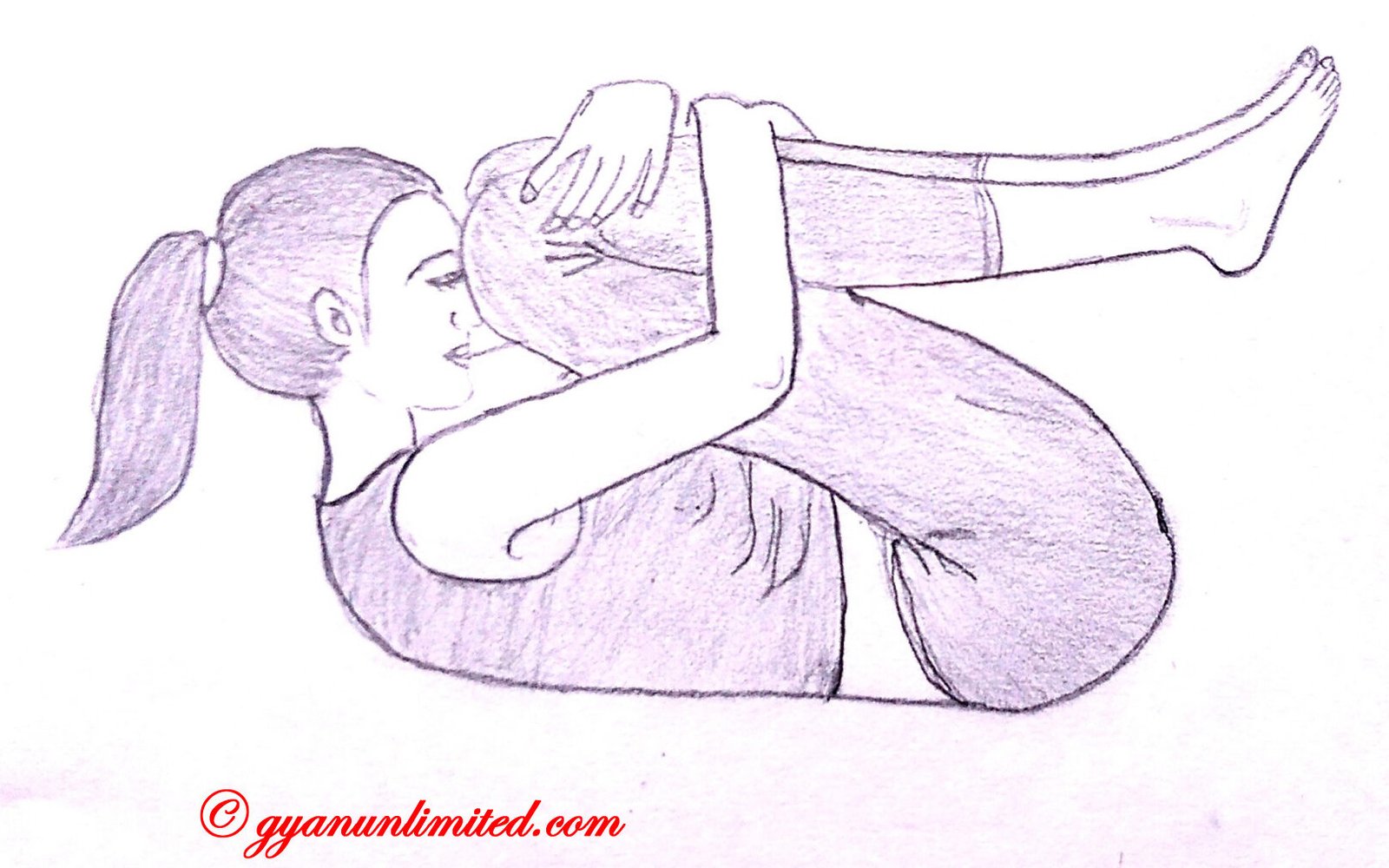
Pawanmuktasana Meaning
Pawanmuktasana is an excellent yoga pose for the health of the abdominal region, traditionally associated with easing stomach heaviness, increasing blood circulation and nerve stimulation, and releasing trapped abdominal gases. It is considered an important pose for supporting the digestive system. Pawan means air or gas, Mukta means release, and asana indicates a yoga posture — together describing “the gas-releasing pose.” It is also known by several other names, including Wind Relieving Pose, Wind Liberating Pose, Breeze Removing Pose, and One-Legged Knee-to-Chest Pose, and is pronounced puh–vuhn-mukt-aahs-uh-nuh.
Even relatively unfit or unhealthy individuals can generally attempt this pose, though anyone with a relevant health condition should read the precautions section below first. It can traditionally be practised at most times of day, though it’s best avoided immediately after a meal.
How to Do Pawanmuktasana
The basic steps of the pose are as follows:
- Lie down in a straight, supine position on your back.
- Inhale and raise your legs to a 90-degree angle.
- Exhale, bend your legs, and bring your knees toward your chest.
- Clasp your knees by interlocking your fingers around them.
- Raise your head and gently try to touch your forehead to your knees.
- Breathe normally and steadily while holding the position — there’s no need to hold your breath.
- Slowly bring your head back down first, followed by your legs.
- This completes one round. Repeat for 2 to 3 rounds.
Why Practice the Right Leg First?
Many traditional instructions recommend performing this pose one leg at a time, starting with the right leg before the left. The reasoning given in yogic texts relates to the natural path of the digestive system: after digestion in the small intestine, waste matter moves into the large intestine, which rises upward along the right side of the abdomen, crosses horizontally near the navel, and then descends on the left side before reaching the colon. Practising with the right leg first is traditionally believed to support this same natural direction of movement.
Practising in Stages
For a more structured practice, Pawanmuktasana can be broken into three stages:
Stage 1: Bend the right leg and bring it as close to the chest as comfortable, keeping the left leg straight and stretched along the floor. Interlock your fingers over the knee, breathe out as you raise your head toward it, hold the position while breathing normally, then breathe out slowly as you lower back down. Repeat for 2-3 rounds.
Stage 2: Repeat the same steps with the left leg bent and the right leg extended, for 2-3 rounds.
Stage 3: Finally, bring both legs toward the chest together and repeat the same breathing pattern, for 2-3 rounds.
Benefits of Pawanmuktasana
- Massages internal organs: The gentle compression involved stimulates the abdominal muscles and nerves, increasing blood circulation and supporting the efficiency of the abdominal organs.
- Removes trapped gas: The primary traditional purpose of this pose is releasing trapped gas and easing a feeling of stomach heaviness.
- Supports digestion and constipation relief: By supporting smoother digestion, the pose is traditionally associated with easing constipation.
- May support fat burning and weight management: Regular practice, combined with suitable stretching and twisting, is traditionally associated with supporting weight management, particularly around the abdomen.
- Reproductive health: The pose gently massages the reproductive organs and is traditionally associated with supporting healthy ovarian and testicular function.
- Lungs and heart: Traditionally considered supportive for general lung and heart function, within the limits noted in the precautions below.
- Spinal flexibility: Supports flexibility through the lower back and spine with regular practice.
- Menstrual comfort: The gentle massage to the pelvic region is traditionally associated with easing menstrual discomfort (outside of active menstruation, when the pose should be avoided — see precautions).
- Circulation: Supports healthy blood circulation to the abdominal and pelvic region.
Precautions and Contraindications
Pawanmuktasana should be avoided under the following conditions:
- Recent abdominal surgery
- Neck strain or neck pain
- Pregnancy
- Hernia
- Piles (haemorrhoids)
- During menstruation
- Hyperacidity
- High blood pressure
- Heart problems
- Slipped disc
- Testicular disorders
A Few More Practical Details
- Level: Basic / beginner-friendly
- Duration: 10 seconds to 3 minutes per round
- Stretches: Abdomen, lower back, arms, thighs, buttocks
- Strengthens: Back, digestive system, reproductive system
- Main focus areas: Abdomen, thighs, hips, buttocks
Preparatory Poses
- Supta Pawanmuktasana
- Sulabh Pawanmuktasana
- Setu Bandhasana (Bridge Pose)
- Raised Leg Pose
- Ardha Halasana (Half Plough Pose)
Follow-Up Poses
- Setubandhasana
- Matsyasana (Fish Pose)
- Chakrasana (Wheel Pose)
- Salabhasana (Locust Pose)
- Dhanurasana (Bow Pose)